Saturday, August 20, 2011

Gooseberries and Peacock eyes

Two weeks ago I returned from Sweden. I was there for almost a full month this year, which I am truly grateful for. It gave an opportunity to reconnect with my family that has left a lasting impact.
We stayed in my parents old house right outside Stockholm. We were blessed with sweet, fresh summer weather and did lazy day trips around town. I took lots of pictures, although perhaps not completely representative of Sweden as a whole. Just more random shots of what I take pics of anyway - plants, birds, butterflies and other critters!

An Elderberry variety with red drupes of berries, Sambucus racemosa, with rich deep red fruits. They are toxic, at least to people.
 

The Sambucus bushes were growing in a field next to an old cherry orchard outside a restaurant (Brostugan at Kärsön), and I picked the cherries that were within reach and we had them for dessert. The trees were enormous. The kids were in the playground and I explored with my camera.


Next to the Elderberries the field was covered in thistles, which in turn were covered by all sorts of fluttering things. The Eurasian Ionachis Io butterfly is so beautiful and the colors are so saturated, they stand out from the picture as if you had enhanced it too much. In Swedish it's called Peacock Eye, Påfågelöga.


Outside my parents house I found the leaves of a dear friend. Hepatica Nobilis, Blåsippa, one of the most Swedish flowers of all, are of course done flowering months ago. In the US it's almost identical - Round-lobed Hepatica, which I took some pictures of earlier this year.

This little wild Geranium covered the ground in their very neglected yard and elsewhere. The leaves turned a pretty red, possibly because of the draught - there was no rain for 3 weeks straight in Stockholm, and birch trees and lilacs were dying. The Swedish family is called Näva, but I couldn't figure out which one of a few it was.

At another cafe, just by the waterside, the kids spent the afternoon feeding the ducks in the water. I looked in my bird book in the Duck section but could not find this black and white guy. I had to look through the entire book before finding out that this was the Eurasian Coot - sothöna in Swedish.

A common cutie, Great Tit, was feeding from the tables at the cafe. Talgoxen is spread all over Eurasia, does not usually migrate, has many many subspecies.

It's always a pleasure to taste the fruits and berries from back home. I hadn't had Gooseberries in a looong time. These were planted outside my friend's apartment complex for everyone to enjoy, and were so sweet, juicy and ripe.

Gooseberries are still somewhat illegal in Massachusetts, since they are a shared host of White Pine Rust. At some point Gooseberries and Currants, wild or cultivated, were being pulled up in an effort to eradicate this disease, because of the damage it caused to the forest industry. I say somewhat illegal, because it seems that science has proven that the Ribes species were not as detrimental as previously thought, and more and more cities and counties are now easing up on the law. I look forward to the day when I have a garden big enough to host a number of these plants.


Gooseberries have a long history in Europe. There were hundreds of varieties and many were unique to each country. The berries were supposedly large as plums and so delicious that poems were composed about them. Then came a pest and killed almost all of the older cultivars, and Gooseberry have not yet recovered its' former glory. In the US I have seen it once in a Farmer's Market, but it seems fairly unknown yet. You eat them with cream or make jam out of them.

Another favorite place of mine is Bergianska Trädgården, the "Bergian" Gardens. Now funded by the University, it has a section of plantings laid out to illustrate the plant families, but a lot of that were not in shape right now. My favorite part is the Herb, Medicinal and vegetable gardens, which looked fantastic as always. This kind of old fashioned Herb garden is so beautiful and so full of history and tradition. Many herbs, both culinary and medicinal, were brought to Sweden with the monasteries in the early Middle ages, and that's were the plant knowledge resided.

Here is Milo running around the formal plantings, on a quite hot summer's day.

At last, some pictures from a Apple Cider Farm west of town, were a little tiny pond were surrounded by buzzing life. The Swedish version of Joe Pyeweed, Hampflockel, is just as attractive to nectar feeders as their American cousins. The Peacock Eye is battered, maybe at the end of its' life, and it didn't waste a minute here.

Friday, July 15, 2011

Oh I will miss you!

Leaving for my annual Sweden trip tonight. Not much to complain about, except...

The Joe Pyeweed in my backyard is so close to bloom...

My Summersweet has big buds and my bird house gourds are about to take off...

The lavender in the community garden is still attracting billions of beautiful creatures...

And this Great Golden Digger wasp is busy busy at the onions.

And exactly What will become of this furry moth caterpillar hiding under a violet leaf?

I know most of it will still be there when I get back. And there's plenty to marvel at in the Swedish forests and gardens. I will soon show you.

Saturday, July 9, 2011

Abundance


Summer is here. Abundance of color, fragrance and taste. Whether it's in my backyard, community garden or weeds by the roadside, I love everything about it.

Dock and mugwort

Grass and chickory

Green bee on aster

 Painted Lady in my backyard

 White currant in my community garden plot

Tart but absolutely delicious even for Milo

A wasp building nest in my fake birdhouse

Double decker beebalm

Tiny bees mating in California Poppy


Honeybees on onion

Dill stars

The Black Currant - bigger, slightly less tart, with edible leaves as well

My Butterfly weed took three years from seed to this but so worth the wait

A bug most vegetable gardeners do not appreciate - Squash Vine borer Moth. She will lay her eggs in the vines of squashes and pumpkins and the larvae will almost certainly kill the vine. Enlarge to see her funny looking furry appendages? dangling from her body.
  
A question mark

This Tiger Swallowtail was in Franklin Park, spotted by my son who knew how excited I would be to see it. Enlarge the picture to see the nectar feeding tube elegantly rolled up, and to take a look at the great coloration of the body as well.

A wasp carrying a green larvae almost her own size. Is it going to be food for her eggs?

Friday, July 1, 2011

How to plant a tree

The reason why I went to Garden in the Woods the other day was a workshop in tree planting, but I sort of got caught up in admiring the azaleas that were blooming and never posted anything from the workshop.

Our instructor was Rolph Briggs, a wellknown arborist with many projects under his belt. He is the man in the hat, as we are we are gathering around the pot-grown birch we have the honor of planting on the sacred grounds of the Wild flower Society.

I will not go into much detail about the workshop - it's actually pretty basic stuff. Unfortunately, trees today often get planted too deep which will eventually kill them, since the root system does not retrieve enough nutrition when it's buried under too much soil. This is partially because many people have the wrong idea of how trees grow their roots - we still tend to think they grow deep down, when they actually spread outwards and never really go any deeper than 6-18 inches. And it's partially a consequence of nursery machinery that digs up the young trees and wraps them in burlap for delivery to stores. The machine throws a lot of dirt on top of the root ball, and then the customer assumes the proper depth being the top of the burlap ball, when in fact the root flares should be clearly visible, and those extra inches of soil should be brushed off. He showed us how to remove soil from the trunk of the tree so that we could all see the first primary roots. If some of them were crossed, as roots will be if they've been confined to small pots for too long, the crossing roots need to be cut off so they won't be girdling the tree when the root keeps growing. This seems self evident - but there's still quite a lot of resistance and ignorance around the subject.

Here the primary roots of the tree are exposed and it can now be planted with the root flare clearly visible.


Once he hole was dug and the plant's roots were freed from the confining shape from its tim ein the container, the measuring stick came out. The tree was placed in the hole, and pretty much all of us was surprised to see that it really shouldn't go any deeper than this.


Again, we checked the depth with stick and a shovel. 

and then we carefully filled up the hole with a gentle mix of compost and soil.


The special mulch came on

And although the tree was standing firm, we staked it for good measure.

Now, on the way home I couldn't help but notice how this new development has their trees planted deep and buried under vulcanoes of mulch.

If your trees look like this, please liberate them as soon as you can from the vulcano of mulch, and if it can't be replanted, at least don't bury it!


White moth identified...

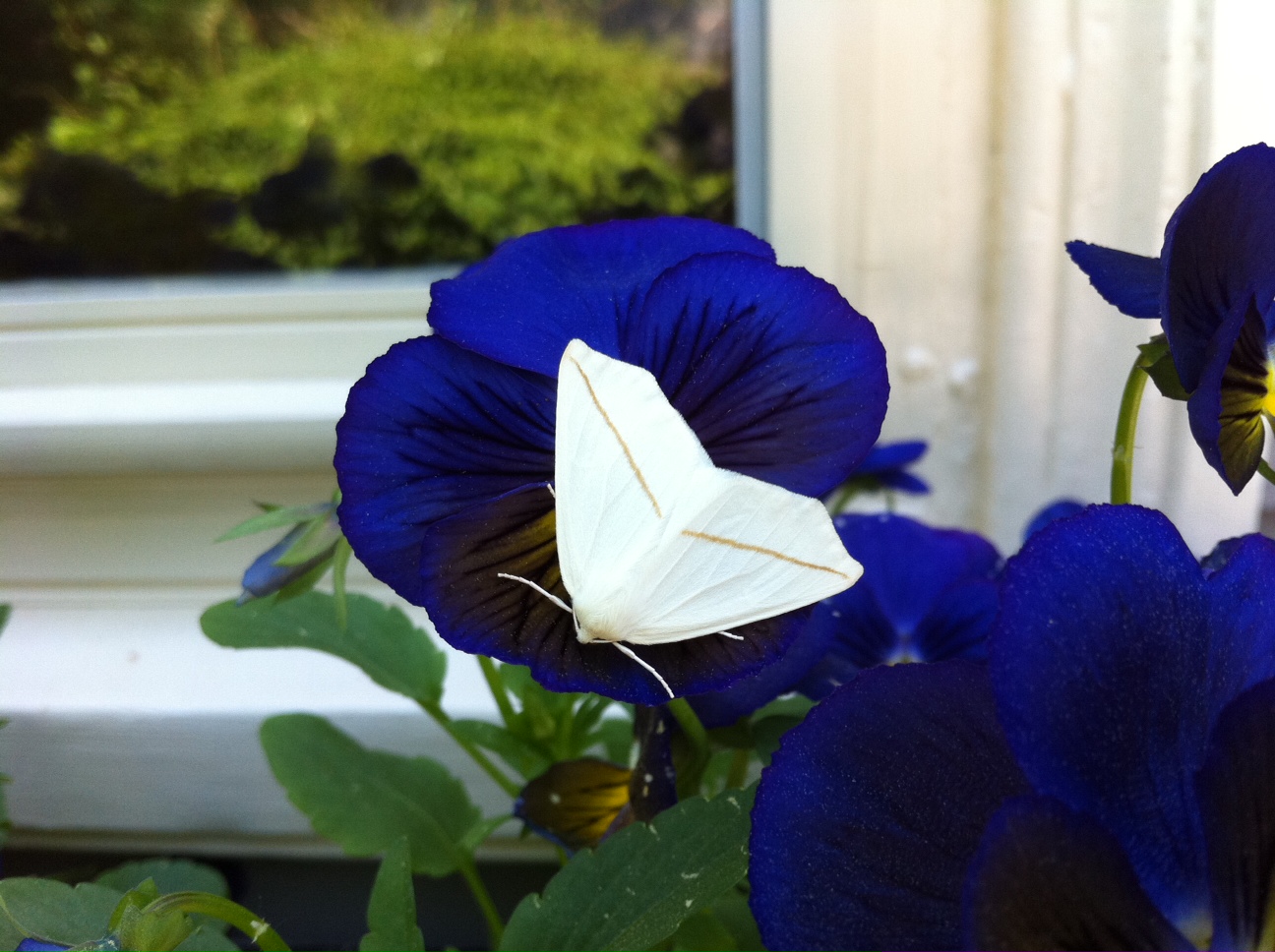
A few weeks ago I saw this white moth resting in a planter with pansies. It was so white and neat, and the planter so tidy and non-natural, and I thought they sort of fitted well together. I wrote to Bugguide.net (thanks for that one too, Jackie!) and in a few days they returned with the answer.

The White slant-line moth (Tetracis cachexiata) is maybe better known in its caterpillar form, where it tries really hard to look like a twig.
This picture I downloaded from google since I wanted to show what a completely different creature its larva is.

It feeds on many different kinds of trees, and can be found along the East Coast from Canada to Florida.