Monday, March 12, 2012

A home for a day

Above is the stand of tall pines that became our home base for a day. The dappled sunlight was shining on the forest floor. 
Fungus with green algae, ferns. In all the grey- and brown-ness that is the woods this time of year this soft green covered log was shining as well.

A gentle wind swayed the pines, making a soft but mighty sound.

Our goal was to climb one of the tallest of the pines. While ropes were set (by people who can set ropes higher than I can) I explored the very nearest surroundings. Lots of red maples, pines, quite a lot of storm damage from an October storm that affected this area.

The only thing that gave the identity of this scraggly little tree away was the oak gall.
 

This was a mystery tree. Looking like nothing else on the site, we thought it might be a very young Cucumber Magnolia, who happens to extend north into this very forest. When I was back at home I used my excellent tree bark ID key. Turns out our young tree might be a hickory - pignut, shagbark or mockernut. Since there were no mature shagbarks around - they're easy to spot - it might be one of the others. The cucumber magnolia likes wet feet, and this was close to a swamp but on a hillside. Next time we go we will take a good look again.

It was spotted with lacy strands of lichens or liverworts.
As they often do, preparations took some time (that I didn't mind the least - I was in my home the forest) but eventually the 4 of us were ascending this giant. Pine trees often loose their lower branches while growing and to find a live, safe branch to hang a rope from, we needed to aim very high. In this picture you can see three of the ropes, I'm in the yellow helmet.
The tree was so high we had to use what's called SRT or single rope technique - the branch was simply too high up for hanging the rope over it and climb on both ends. This way, one end of the rope was fastened in the top (by the most experienced climber of us, Andrew), and then the rest of us climbed up using the hanging end. It was a nice bouncy feel. And see what a trunk this tree has!

At about 90 ft up we reached our rope ends and re-set them higher up. At approximately 115 ft I took a snack break and ate my apple.

Up there, we had two different worlds to take in. One small, close by, with lichens and beetles and shining drops of sap.  
Maybe this beetle lives his whole life in the tree tops, or maybe he's just passing by.


The bark of a pine tree looks very different up here - smooth and grey.


A closer look at the ropes and the gear that is holding us up.

Looking out from the tree we could see a distant horizon. We could see the red maple buds close to bursting. We heard winter wrens, golden crowned kinglets, chickadees and distant crows.

Going down is always with a certain sadness - you will end up in the usual world again, the flat and two dimensional one. Plus, all the effort you spent getting up means you want to get a good chunk of time up there! But there's always another time.

Getting back to the car took its time. Rarely do I meet someone who likes to talk about trees non-stop  like me, so there was lots to see and explore on the way back.

Here is the enormous cucumber magnolia. I'll be so excited to see it in bloom!

Pine branches and moss make a nice color composition.
A wild holly.

A little swamp, inhabited by turtles, frogs and other critters.

I look forward to coming back here!

Friday, January 27, 2012

It's a bird's world

  
 Outside my kitchen window I have my bird feeding station. The camera is always on the pantry shelf and I take an occasional look every now and then. Sometimes I end up staying for longer stretches, watching them come and go.
 

The downy woodpeckers are my most frequent visitors - two couples. But a couple of times I have been honored a visit by the Hairy woodpecker - larger and with longer beak.  If you compare with the (very wet) downy female in the next picture you can see the difference. Otherwise it can be hard to tell, they look very similar.


 Not all visitors are there for the seeds. This Cooper's hawk came by a rainy morning and sat right outside. By the suet feeder the small wet Downy sat veeeeery still, and survived unnoticed. I kept the memory of the hawk's eyes with me all day. (You can't see it in this picture, but Cooper's are easy to identify if you see their tail feathers with 3 distinct bands.)

A few days later it returned just briefly. You can only tell the sex by their size, females are larger, so it is hard to tell without seeing them both at the same time. I would not be surprised if this one is a female.

 Some visitors are a little less welcome than others. The starlings didn't show up until March last year so I felt that I had been able to nurture my little friends for a long time, but this year they have been around from the start. European starlings are aggressive towards other birds at the feeders and also when it comes to finding nest sites. When they're at the feeder they come in groups and don't leave until the food is gone.
 The redbellied woodpecker is a feisty big bird but was eventually bullied away by the starling and his flock.

 I decided to take down the suet feeders for a few days hoping that the starlings would move on. And it helped a bit. Next picture is of the redbellied woodpecker trying to eat from the regular feeder. Woodpeckers have stiff tail feathers to support them against a vertical tree trunk. He has to work harder to access the food from this feeder.


On a snowy day -or should I say The snowy day we had! - the juncos move in from the forest. They fluff up their feathers with air to keep warm. They only eat from the ground so I make sure to throw out some extra for them and the mourning doves.
 

I wasn't surprised to see the hawk again during the snowfall.

The white throated sparrow is another ground feeder that often comes in bad weather. There is one pair, seemingly very shy, usually only comes by in the morning. Their feather pattern is very intricate and pretty.
 I do love my little chickadees. I have seen up to 6 at the same time, they take orderly turns and seem territorial without aggression. I still haven't managed to get them to feed from my hand, but they are definitively the most courageous ones and often return to the refilled feeder even before I'm back inside.
The cardinals rarely make it over but I see them in the yard.

 I have a resident couple of nuthatches, eating both suet and seed.


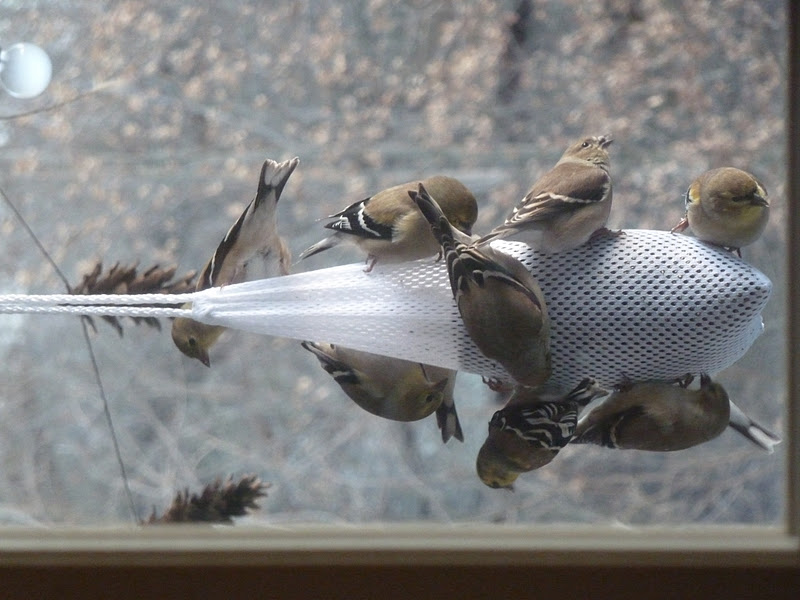
When it snows, it also shines of goldfinches! Goldfinches don't appear to be too territorial, they easily share space and don't chase away any newcomers. As a contrast, I watched three male house finches fight each other so hard for space at the feeder that little or no eating was accomplished.
 I've also had time for one more tree climbing adventure, this time I was joined by my 
husband. My friend and climbing mentor Andrew Joslin helped us arrange for a birthday party together up in a white oak. Big thanks to both of these amazing guys for their willingness to make this happen!

Sunday, January 8, 2012

A January weekend


When I signed up for the tree climbing workshop I thought I would probably like it, but didn't really anticipate that I'd get crazy about it. When the weather forecast for Saturday looked warm and the word spread that a climb would happen I got so excited I had almost trouble sleeping.

In the city of Milton, MA, lies a small unknown public wood with great oaks and beeches. Last time we were there we saw the beautiful deer family and a turkey flock. Yesterday we headed out there with a vague plan of making a traverse between two trees to swing on. The two great beeches on the photo above seemed a good distance from each other.

I love tree climbing, but I'm still at a point where I constantly need assistance from the others, which is really frustrating. At more than one moment I found myself staring at a rope or a piece of equipment trying desperate to remember what I was supposed to do with it, and I had to ask for help again and again. The good thing is that when I finally get self-sufficient at this there will be opportunities for me to give back, at one of many volunteer teaching sessions that my instructor gives.

Here three of us are on our way up, the fourth is holding the camera. Nancy on top, Paul in the middle and I am just getting started. I didn't set my own rope this time, I tried to throw a line a number of times but this tree was taller than anything I had done before. Andrew Joslin, my instructor, got lines up for me and Nancy, and then he used a slingshot to throw one for himself.

Here is my self portrait from about 60 ft up.

And here is Andrew's picture of Nancy and me and Paul in the other beech. Andrew has reached to the very top of the tree, perhaps as high as 90 ft. I am already on my second rope, higher set than the previous one.

Boston skyline from my 60ft perch.
 We saw two Cooper's hawks flying and vocalizing. A pack of coyotes howled not far away, and a flock of starlings in the marsh did that thing they do - Murmuration. The flock moves in quick waves as if it was one single body controled by one mind. This was a small flock, but I have seen movies of tens of thousands of European starlings, and it's an unforgettable sight.

Here is Andrew fiddling with one of his slingshots trying to get a line over to the next tree. In the end we realized it would probably get dark soon and we never climbed between the trees.  Not this time.

Dark fell eventually and while we got down, Paul was having trouble with a stuck rope in his tree.

The lights from I-93 
 
 Although not the same warm temperatures today, we decided to drive to an Audubon Sanctuary on the South shore of Boston, which promised both boardwalk by the shore and woods. I wasn't too impressed by the water front area and the boardwalk through the red maple swamp - it was so overrun by invasives and trash that it was difficult to enjoy. But the sumacs by the meadow had nice red seed heads and the alders had the little conelike seeds that I remember from my childhood.


In the woods area, an interesting deformation of a tree.

I know nothing about fungi. This was soft and floppy where I expected it to be hard. For some reason it looked good to eat.

Clubmoss, like little trees.

Wintergreen?

This massive oak fell in a recent storm and brought four other trees down with him. 

Emil climbing towards the light!

I've always loved trees and enjoyed looking at them, but as a tree climber I now look at them with renewed interest. This oak was full of poison ivy but the shape and height looks really good!

At home my Amaryllis is finally flowering, about two weeks after Christmas. Worth the wait though.


Monday, January 2, 2012

Close encounter

As I was walking to the store today I noticed a big bird flying in toward a low branch on a tree in the parking lot outside English High school. I walked over to the other side of the street and in right under the tree. Unfortunately I had only my cell phone and not my real camera (and the gray daylight outside was very bad for photography in the first place), but I've never been so close to a hawk before, close enough that I could say that we looked into each others eyes. Very intelligent hawk eyes, that was.


He was only 6-7 feet over head of me, and I was happy that it didn't fly away. Looking down on the ground I found the reason, a dead squirrel lying in the grass next to the pavement. My theory is that the hawk had previously killed the squirrel but had not had time to finish it, and now the hawk waited impatiently for me to get going so that he could finish his or her meal.

On the way back I looked under the tree. No sign of either squirrel or hawk.

Monday, December 26, 2011

Holidays

Warm holiday wishes from my family and possibly a thousand Canada Geese. They live in Jamaica Plain and spend most of their time between the golf course and the different ponds.

One have to wonder what they are cackling about and what's so important that they all have to speak at the same time, even while flying.
Enjoy!