Monday, April 6, 2015

Heron rookery and Estabrook Woods


I've been absent from my blog. I didn't have a good camera for a long time and I was posting more and more on Facebook. But Facebook postings go by so fast, they disappear in the stream. Eventually I felt that I wanted to make posts again that lasted longer and that I could go back to and look at. Writing a narrative is challenging but I feel some of the pictures deserve more than a caption. I also bought a new camera, Canon SX60, which I absolutely love. Its zoom is so powerful that you might believe I'm standing next to the heron's nest poking it with my my lens, but I'm far away enough not to disturb anything. I'm looking forward to post more this year.

My naturalist and tree climbing partner recently moved to the old, beautiful and affluent city of Carlisle north of Boston. Here the houses are big and gracious, sometimes old, sometimes new but made in typical New England style, and their lots are big and wooded. There are plenty of wetlands preventing further development - not that the Carlisle inhabitants would want any more anyway!

In addition there's a lot of conservation land to explore. Right outside Concord center is a big wetland in between two cemeteries. We have been there before to look at the Great Blue Heron rookery with over 20 nests, and once we also saw a great horned owl.

 This day we didn't see any trace of the owl, but a new song called to us: Rusty blackbirds. They're rare enough to get excited about in this area, although this wetland is just a stop on their migration north.

We then moved along the path until we reached the best spot for watching the herons' nests. Already about 8 herons were coming in and out of nests, one even appeared to sit on eggs.

Here a heron comes in for landing, neck, wings and legs all stretched out.

 In breeding plumage


The next day we decided to explore Estabrook woods, a fairly large conservation area bordering Concord and Carlisle. Much of the land is privately owned. We entered from the Carlisle entrance, and at first we were quite disgusted by the amount of dog poop everywhere. Apparently dog owners park and open the car doors and just let their pups run out without supervision, and the dogs go all over the path before the owners have caught up to them. As expected, the farther away from the entrance the better it got and we got a good walk.

It didn't get interesting until we left the beaten path, though. A bluejay met its fate somewhere under a pine tree.  There were dozens of feathers spread out in all directions but no carcass, so we cannot be sure who killed it. I picked some of the beautiful feathers and already felt it was worth stepping into dog excrement.

 Then we reached a pond. Along the shore were some low, gentle lands where many birds were active. Chickadees and the other foragers were busy, and we saw and heard the Eastern phoebe, just about returned to Massachusetts.

The pond is called Mink pond and it felt like a peaceful treasure. Here are wood duck boxes in need of some renewed attention. I imagined a slow canoe ride over the water trying to steady those boxes up a bit, but I'm not sure if canoes are allowed.

A muskrat!

And an enormous beaver lodge at the other side of the pond.

Wood ducks, ring necked ducks and goldeneyes were in the pond, and a belted Kingfisher flew by, calling. A pair of herons sat on the other shore. I continued imagining being there on a warm sunny day when the turtles would surely sit on those logs in the water and dragonflies would be darting around.

The beaver lodge up closer - no recent activity but the beavers surely have lived here for many generations.

The dam was old and strong enough to walk on and had significantly altered the landscape, as beavers will do.


A first for me - and the first of the season in this area. The osprey were perching here for a long time until it took off to chase away a red shouldered hawk squawking in the woods. Again, although it looks like I'm close enough to touch it, I'm on the other side of the shore.

Looking good among swelling maple buds.

A bit further along the path, a beautiful chatter in the treetops appeared and a flock of redpolls settled down in a tall black birch, which carries their favorite winter food.

They were high up against the sun, about 12 of them. We stayed for a long time.

I was already ecstatic after the kingfisher, osprey, phoebes and the redpolls, and to then get to see this owl right above our heads was almost more than I could handle in one day. In a tall pine right next to the path, its gentle face and sleepylooking eyes followed us when we finally had to move on.


Here is a link to Estabrook Woods, should you ever be in the area and interested in a great hike.


Thursday, June 6, 2013

Mt Mineral weekend retreat


I left town in a rented car, since my own was still under repair. The nicely air conditioned Honda drove me West toward Shutesbury, MA, on the foothills of the Berkshires, West of the Qaubbin reservoir, to an old resort turned retreat called Temenos. Centered around some mineral springs there was once a hotel, twice burned down and forgotten, before some Buddhist minded people bought the land and turned it into a wooded retreat with just a few cabins for rent.

I wondered among the cliffs and the woods, listening to the bird chorus, relaxing in the warm shade. The sun would have been hot, since this weekend reached temperatures in the 90's, but under the trees it was perfect.

I have never seen so many Ladyslipper orchids before - eventually I stopped taking a picture of every one, but not until I had found a least 20.
 

 I know very little about geology and the rocks that form the base for our lands, but I could see it was different from what I see in Eastern MA around Boston. Obviously the ice age have left traces here, with boulders, cracks and ledges.

This photo is taken through the screened porch - my neighbors and resident Phoebes, tending their nest under my roof.


I also saw a long list of birds, some new to me. Pileated woodpecker, blue headed vireo, ovenbird, pine warbler. In the never ending chorus I could hear Eastern woodpeewee, scarlet tanagers, winter wrens, robins, goldfinches, downy woodpeckers,  and red eyed vireo.At night I heard the spring peepers gathering by the pond.


Along a brook, little puddles with mineral rich water. I pumped my drinking water from the well, and the water was slightly reddish from the iron and manganese. I felt a sensation of fullness only after drinking that water.

Neither have I ever seen so many Mountain laurels. I see a lot of it in the gardens I tend to, but there is no comparison to a wood filled of wild ones, about to burst. Next year I will schedule my visit to the second week of June, so that I can walk in among the flowers.

They have beautiful, twisting branches.

Mountain Laurel is an understory shrub, growing under the tree canopy, fighting for a chance in the sun. It is an evergreen, taking advantage of the sun during the winter when trees lose their leaves. Other understory plants like Moosewood or striped Maple below, have enormous leaves.

Hobblebush (Viburnum Lantanoides) is doing the same thing, growing big leaves as sun catchers. I missed the flowers of this one, it must have been a treat as well.

 I never saw any, but I was told that along this cliff ledge with dripping water, you could often see porcupines.

I think I must be part plant - I can so clearly feel the energy coming down from the sky and into the green, green, green...

 Virginia creeper vine was covering some of the rocks. I found it interesting that I did not see any poison Ivy at all in these woods. In Boston, it would inhabit the same kind of woods.

 A few Trilliums, flowers gone


 Star made out of root

Young American toad. It was no bigger than my thumb nail.
Bear claw marks! We were told not to compost and be careful not to leave food scraps around.

 The after-dinner hike lead up to the mountain top and the view of the lake below.

It was there and then that I first heard the song of the hermit thrush. It sang for a good 20 minutes and I followed it deeper and deeper into the woods, mesmerized by its sunset song, until I got a glimpse of it before it flew off and the mosquitos really started to eat me alive.

The next morning all I wanted to do was to find the hermit thrush again, and I did hear it briefly around nine, but then it went quiet.

The retreat had its own little pond, but the water was so bitterly cold that not even 94 degrees could convince me to go into the water completely.

Another lovely wildflower is the Indian Cucumber root.

Back up on the mountaintop again, a better view of the lake, and the great beaver lodge.

Oak leaf gall, like an apple made of rice paper

Below the mountain, a creek of cold fresh water leading to the lake. Gray tree frogs were heard but not seen.

 Under the root system of the fallen trees, a bird built a nest, maybe the winter wren.

 And on the forest floor, little lovely star flower shines.

I hope to post some of the sound recordings I made of the hermit thrush for my next post.

Friday, March 29, 2013

Muskrats, beaver, herons and deer

Northwest of Boston lies a large wildlife refuge area called Great Meadows, including Concord and Assabet rivers and large wetland areas along both of them. Many birders carrying binoculars were there, and we did see many different birds. I'm no expert on water fowl, but I think we saw ringbilled ducks, goldeneye ducks, bufflehead ducks, mallards, geese, and a grebe. A heron and a turkey vulture also flew by. The blackbirds were singing and swallows were flying low over the water.

 This couple seemed to be looking for a proper nesting site.

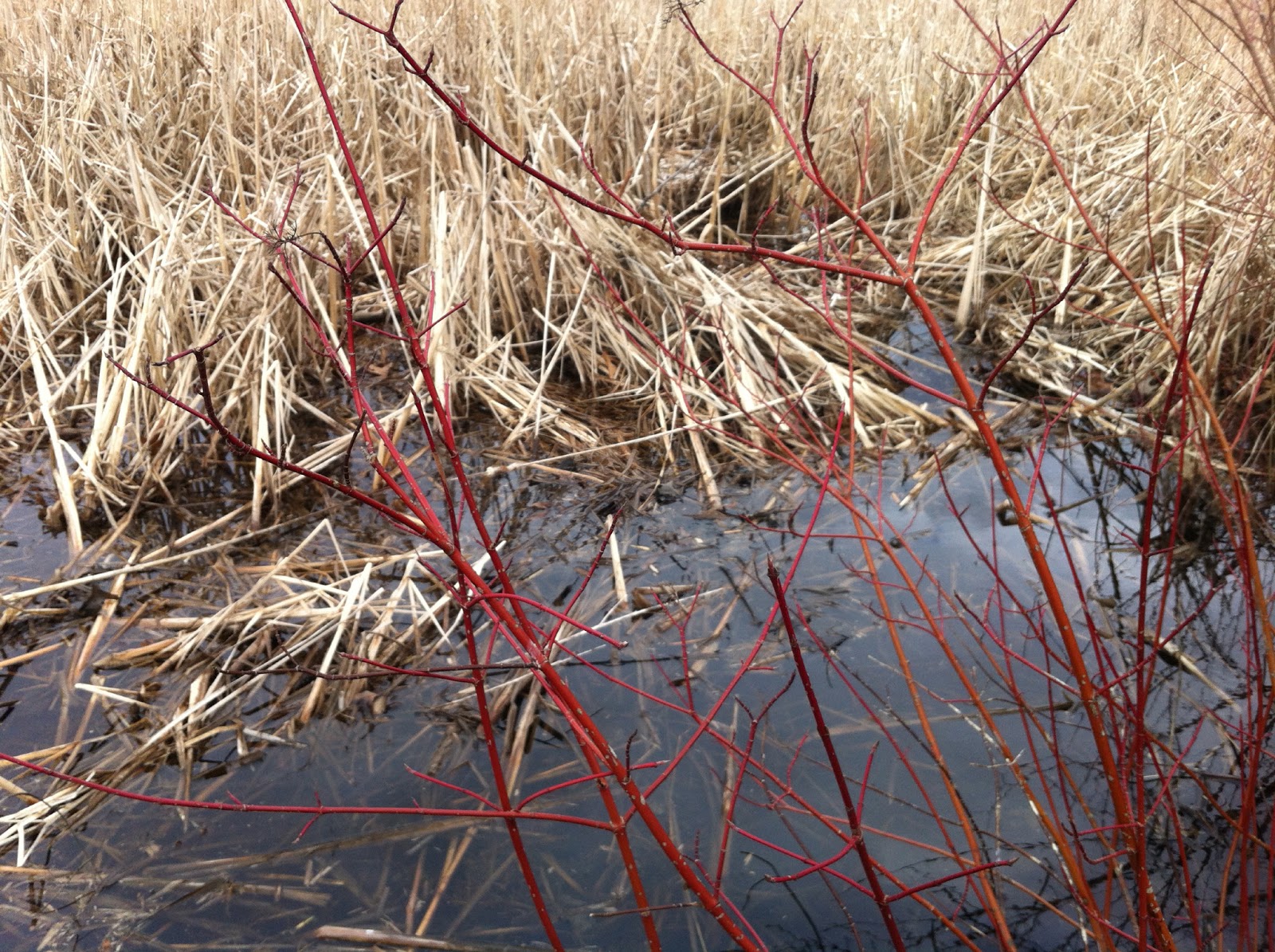
Dogwoods among the cat tails were redder than ever. The boys had lots of fun dismantling cat tails in the wind and made passersby happy with their playing, and all our clothes full of fluff.


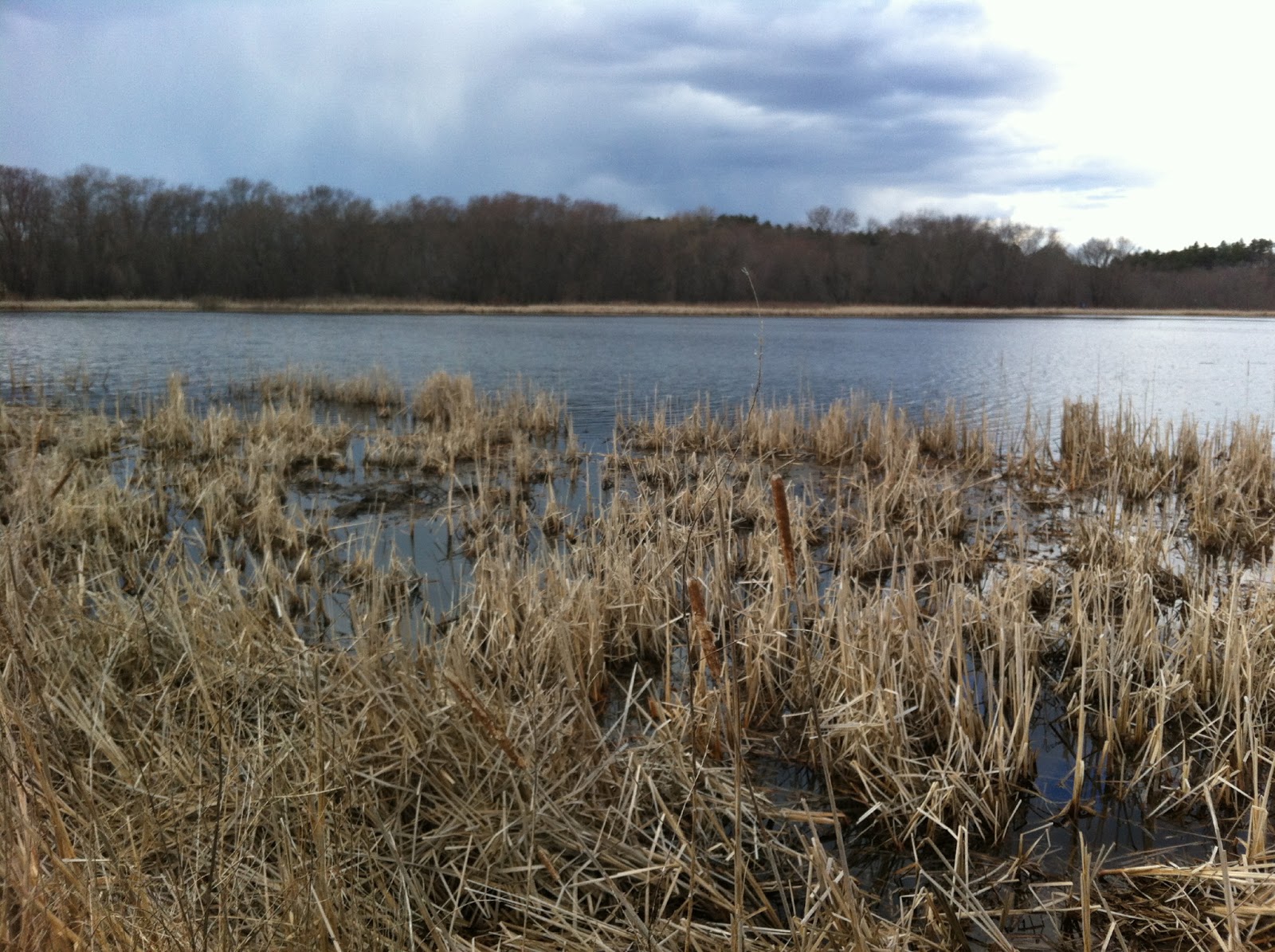
 The sun kept struggling to come out, and we saw dramatic changes in the sky - faraway rain, heavy clouds, rays of sun.

The calm Concord river. The sign told us to watch out for river otters.

This goldfinch greeted us from a maple - almost all molted by now!

This female mallard blends in so well with the ground. She is not yet nesting, but she will hopefully find a safe place soon.
Behind and to the left of her are lotus seed pods. Obviously someone introduced them to this area, I don't know if they stay put or tend to be more invasive. We took some of the dried out pods home to decorate.

We also saw muskrats! They were quite funny, like this one trying to climb on top of the bottom one, give him a rub and then splash back into the water. We saw others pursuing mates and a few just taking it easy and washing their faces very much like a cat does it.

On the way we passed a large rather messy wetland with obvious beaver impact, and in the middle we saw heron nests. We drove in to the cemetery right by and walked down to the water. From there we could count about 10 inhabited nests, and 13 herons, a few sharing a nest. My camera was not cooperating very well, but it was still an amazing sight. We might try to go back, on a sunny morning in about two weeks, and try to get a better look.


On the way out: ripples in the water, and a beaver swam by, but dived before I could take a picture.

We stopped briefly by Assabet river. The sun was coming out, it was close to 7 and it was a gorgeous night. Just a few days ago, my friend saw another beaver swimming by, and doing the characteristic tail splash before diving underwater.
 
And before we finally had to hit the road home again, we saw six deer on a field. I will soon visit this great place again.