Saturday, April 25, 2015

The birds that left and came back

In the morning of March 10th I heard a New Sound that had joined the regular morning calls of chattering sparrows, goldfinches and bluejays. I couldn't figure out what it was even though it was right outside my house. Then I looked out at the feeder, and there it was. "A Grackle!" I yelled to anyone who might be around. He had just arrived to my frozen and snowy backyard.

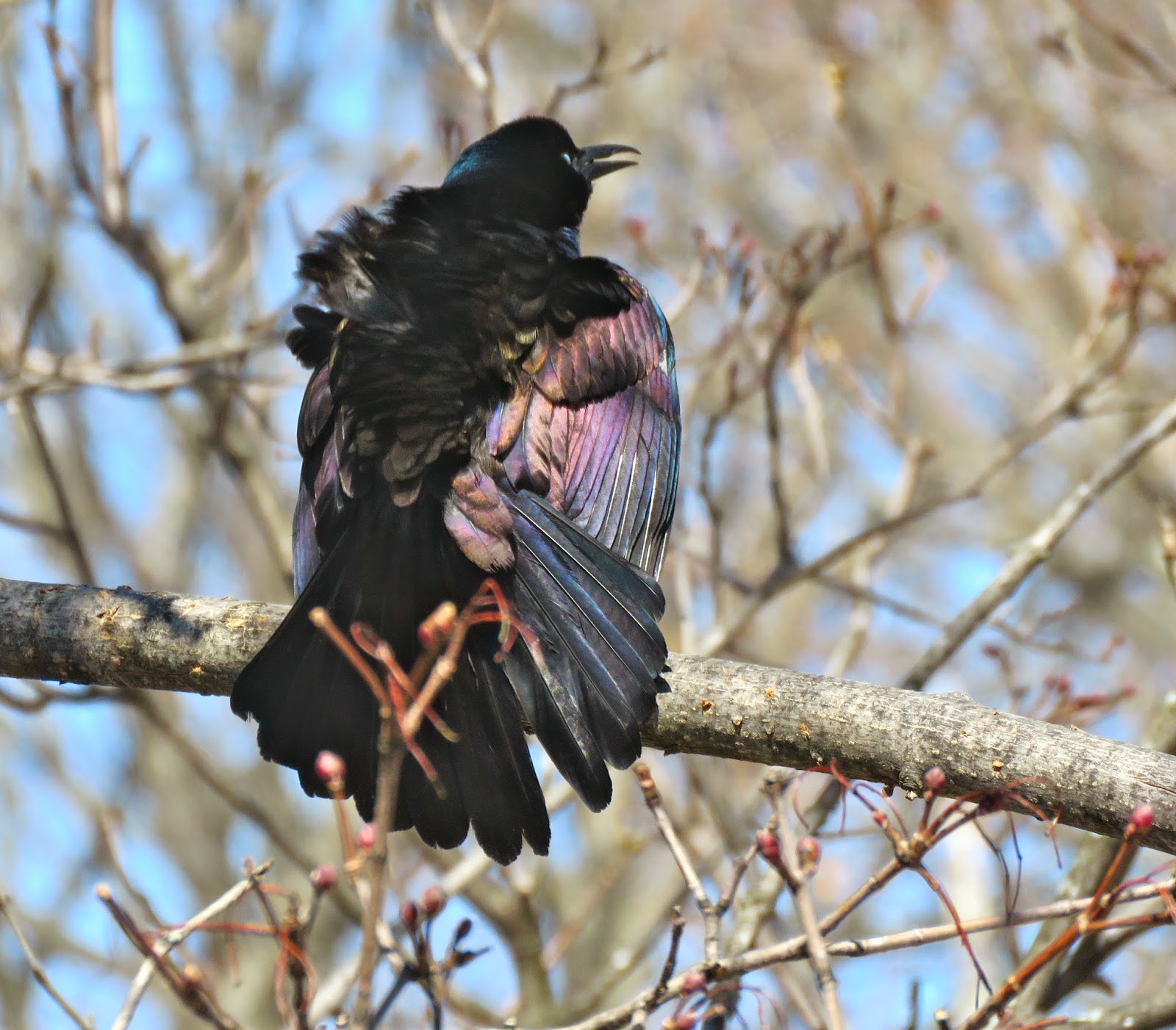
The first flock were about four males. Noisy, conspicuous, gorgeous looking.

This individual had a white spot on his forehead. Later on I also saw another with a white tail feather. 

 A display to deter other males - the females hadn't arrived yet.


 And now the grackles are nesting again in the same conifer tree in my yard for the third year in a row. I don't know if it's the same pair or if it's their descendants, but I've learned to expect them now.
 
Next to arrive was the redwinged blackbirds. Their loud song is a wonderful spring sound. I felt bad though, since we still had very cold nights and quite a lot of snow left.
 
My new camera gave me the opportunity to see a new pattern on the back of the blackbird that I'd never seen before.
 And right then came the male brownheaded cowbirds. For a few days they were hanging out around my porch feeder, eating and bickering in the tree.

 
This little guy stumped me at first. In early morning it came, wet, tired and ravenously hungry after a long night flight. Eventually I learned it was a female cowbird. After eating and resting she was on her way, while the males still hang around for a few more days.

Three kinds of blackbirds in one photo!


Thursday, April 9, 2015

The birds that stayed for the winter

 This winter people in Boston were often on "french toast alert", meaning that whenever there was another snow storm coming in everyone went out to buy milk, bread and eggs. I also made sure I had lots of bird food around! There were days when I had hundreds of visits. Since I got my new Canon camera I've been able to zoom in really close and here are some of the pictures I like the most.

Many birds, especially the mourning doves, often spent part of their day in the maple by my feeder. On a cold day their feathers were all fluffy. Often I had up to 30 of them, waiting for me to throw seeds on the floor for them every morning.
Another regular was this house finch. One day in late March he started singing, and soon after he was joined by a mate.  

I think many people have often wondered what evolutionary benefit a bird can get from being so flamboyantly colored, like the cardinal. Surely any predator can spot him for miles? But in the green shades under the canopy, red is not shining bright but looks more brownish-dull. The birds can move from light to shade and use it to their advantage in mating games. At least that's what David Haskell speculates on in his wonderful book "The forest unseen", which I just finished reading.

I find the female cardinal almost more beautiful, once I've seen her subtle colors up close. 

A couple of wrens were also regulars - they kept singing through much of the winter! 
 
I learned that although nuthatches join mixed species foraging flocks during the winter, they remain in pairs and do not seek new mates in spring.
 
A junco gets a break from the cold and does some grooming in the sun.

Downy woodpeckers are some of the most frequent visitors, but the redbellied is not as common. Here they are in the same maple, which must now be one of the most pecked-on trees in the neighborhood!
 
A single tree sparrow was hanging out with the house sparrows this year.

Every morning and every afternoon at dusk the Whitethroated sparrows showed up. This afternoon sunset lit gold on the branches behind. 
There were always chattering and bickering goldfinches around. 

Another type of visitors soon showed up as well. I think this was a sharp shinned hawk, but it is not easy to tell. The tail is long and slender with a sharp end.

 This on the other hand I think is the Cooper's hawk, that came almost every day for a few weeks. It was big so I assumed it was a female. I never saw her hunt so maybe she just came to sit and watch. It was easy to tell when she arrived because all the song birds went dead quiet, and the mourning doves all took off with a loud whistle of wings.
 Details of feathers

Quite fierce...

On another day this juvenile Cooper's came by like a storm wind. Not yet red eyes and with a different pattern on the chest, it was still very impressive and very capable of stirring up the feeder community.

One of the snowy days this redtailed hawk stopped by, periodically shaking the snow off much like a dog would do.
 
During a trip to Vermont on February break I stopped by a garden when I saw a flock of birds in a fruit tree. Bohemian waxwings! What a treat. 


Before the woods were covered in 4 feet of snow I managed to get out to a few of my treasured places. At Ponkapoag pond reservation in the Blue Hills I saw a hermit thrush that had not yet migrated this December day, I wonder if he stayed for the rest of the winter. His song is one of my most favorite spring sounds.

An American tree sparrow posed at Millenium park down by Saw mill brook.

That's also where I saw this raven, through the car window on the way out!

   My friend in Carlisle had a slightly different set of feeder visitors than my inner-city station. Bluebirds are just too blue to be real...
Bluebird and Hairy woodpecker 
Pine siskins and goldfinches go well together.
 

The siskin's bill seems longer and more pointed, to reach deep into pine cones.
 Goldfinches with a patchwork of tan and yellow feathers. It's snowing, but hormones are bringing out competitive behaviors along with the new molt.


Monday, April 6, 2015

Heron rookery and Estabrook Woods


I've been absent from my blog. I didn't have a good camera for a long time and I was posting more and more on Facebook. But Facebook postings go by so fast, they disappear in the stream. Eventually I felt that I wanted to make posts again that lasted longer and that I could go back to and look at. Writing a narrative is challenging but I feel some of the pictures deserve more than a caption. I also bought a new camera, Canon SX60, which I absolutely love. Its zoom is so powerful that you might believe I'm standing next to the heron's nest poking it with my my lens, but I'm far away enough not to disturb anything. I'm looking forward to post more this year.

My naturalist and tree climbing partner recently moved to the old, beautiful and affluent city of Carlisle north of Boston. Here the houses are big and gracious, sometimes old, sometimes new but made in typical New England style, and their lots are big and wooded. There are plenty of wetlands preventing further development - not that the Carlisle inhabitants would want any more anyway!

In addition there's a lot of conservation land to explore. Right outside Concord center is a big wetland in between two cemeteries. We have been there before to look at the Great Blue Heron rookery with over 20 nests, and once we also saw a great horned owl.

 This day we didn't see any trace of the owl, but a new song called to us: Rusty blackbirds. They're rare enough to get excited about in this area, although this wetland is just a stop on their migration north.

We then moved along the path until we reached the best spot for watching the herons' nests. Already about 8 herons were coming in and out of nests, one even appeared to sit on eggs.

Here a heron comes in for landing, neck, wings and legs all stretched out.

 In breeding plumage


The next day we decided to explore Estabrook woods, a fairly large conservation area bordering Concord and Carlisle. Much of the land is privately owned. We entered from the Carlisle entrance, and at first we were quite disgusted by the amount of dog poop everywhere. Apparently dog owners park and open the car doors and just let their pups run out without supervision, and the dogs go all over the path before the owners have caught up to them. As expected, the farther away from the entrance the better it got and we got a good walk.

It didn't get interesting until we left the beaten path, though. A bluejay met its fate somewhere under a pine tree.  There were dozens of feathers spread out in all directions but no carcass, so we cannot be sure who killed it. I picked some of the beautiful feathers and already felt it was worth stepping into dog excrement.

 Then we reached a pond. Along the shore were some low, gentle lands where many birds were active. Chickadees and the other foragers were busy, and we saw and heard the Eastern phoebe, just about returned to Massachusetts.

The pond is called Mink pond and it felt like a peaceful treasure. Here are wood duck boxes in need of some renewed attention. I imagined a slow canoe ride over the water trying to steady those boxes up a bit, but I'm not sure if canoes are allowed.

A muskrat!

And an enormous beaver lodge at the other side of the pond.

Wood ducks, ring necked ducks and goldeneyes were in the pond, and a belted Kingfisher flew by, calling. A pair of herons sat on the other shore. I continued imagining being there on a warm sunny day when the turtles would surely sit on those logs in the water and dragonflies would be darting around.

The beaver lodge up closer - no recent activity but the beavers surely have lived here for many generations.

The dam was old and strong enough to walk on and had significantly altered the landscape, as beavers will do.


A first for me - and the first of the season in this area. The osprey were perching here for a long time until it took off to chase away a red shouldered hawk squawking in the woods. Again, although it looks like I'm close enough to touch it, I'm on the other side of the shore.

Looking good among swelling maple buds.

A bit further along the path, a beautiful chatter in the treetops appeared and a flock of redpolls settled down in a tall black birch, which carries their favorite winter food.

They were high up against the sun, about 12 of them. We stayed for a long time.

I was already ecstatic after the kingfisher, osprey, phoebes and the redpolls, and to then get to see this owl right above our heads was almost more than I could handle in one day. In a tall pine right next to the path, its gentle face and sleepylooking eyes followed us when we finally had to move on.


Here is a link to Estabrook Woods, should you ever be in the area and interested in a great hike.